



 Going
Electric - With Electro Flyer!
Going
Electric - With Electro Flyer!

















| A Family Affair! |
 By
Mark Stringer
By
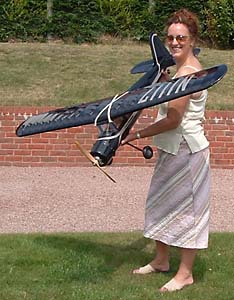
Mark Stringer Well it's been a busy month again! At last there has been another couple of decent flying days - and just as well as Louise, my wife, had finished her new model and we just had to take it for it's maiden flight.
As I mentioned last month she has been working on an old kit I bought for her some time ago. This was to replace her Flair Piper Cub, which did a mysterious wing clapping stunt at about 100 feet and swirled to its demise.
Louise is as enthusiastic as myself about Electric flight so she asked that her next trainer be electric. "Not a problem" I said, trusting one of my Team Gear units to do the job.
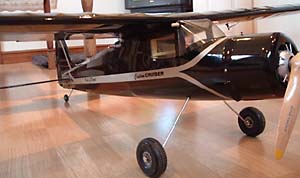
The model is an "International Sailplanes" "Custom Cruiser" named "The Pride Of Detroit". The company, which was based in Wales, seems to have ceased trading some time ago but I had picked the kit up intending it to be Louise's next trainer.
As she had built the Cub herself, with assistance from myself she wanted to do the same with this one, even though this was much more of a kit than the Cub.
 The
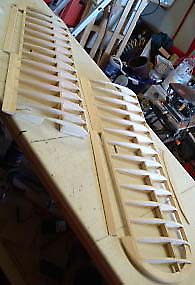
kit itself was nicely produced using CNC cut parts; vac formed cowl, canopy
and windows and was fairly complete except for the wheels (and fuel tank
if it was used for glow power).
The
kit itself was nicely produced using CNC cut parts; vac formed cowl, canopy
and windows and was fairly complete except for the wheels (and fuel tank
if it was used for glow power).
It has a span of 63" and designed for 40 size engines. In view of this I decided to use a Team Gear Sport Twin.
Louise set to work, starting with the wings. All traditional construction, ribs and spars etc. While they were curing at various stages she worked on the tail plane and fin, again all built up construction.
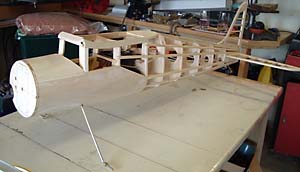
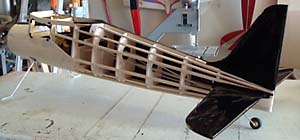
Once these were at the stage where they could be taken off the plan she started work on the fuselage. One half of the fuselage was built flat on the plan and then once removed the second half of the formers were added. Stringers and longerons gave it the rest of its shape, and very nice it was looking too.
I was not too worried about weight as I knew the Sport Twin would have plenty of power for it so everything was made plenty strong enough for a trainer.
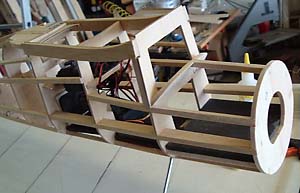 The
front end was sheeted in 1/8 balsa. This was done by soaking the outside
of it in warm (important!) water and then bending and gluing in place.
This worked really well and gave me the inspiration to work on a renovation
project of my Graupner Cirrus - I will cover this next month, but be warned
it will make fans of the Cirrus wince at what I do to my 24 year old glider
- but it will be worth it, honest!!!
The
front end was sheeted in 1/8 balsa. This was done by soaking the outside
of it in warm (important!) water and then bending and gluing in place.
This worked really well and gave me the inspiration to work on a renovation
project of my Graupner Cirrus - I will cover this next month, but be warned
it will make fans of the Cirrus wince at what I do to my 24 year old glider
- but it will be worth it, honest!!!
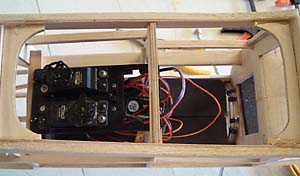
During construction I interfered a couple of times as I had to make small modifications to formers and radio positioning to allow me to get two 7 cell packs inside comfortably and be able to get them in and out through the wing opening.
 I
also did the paint job on the cowl and while there I though to myself
- "Wouldn't this look great with a rotary engine in the front"
- so I put a dummy radial together for it while I was working on the cowl
and getting the engine mounting sorted out.
I
also did the paint job on the cowl and while there I though to myself
- "Wouldn't this look great with a rotary engine in the front"
- so I put a dummy radial together for it while I was working on the cowl
and getting the engine mounting sorted out.
Louise did a lovely job on the model and I tried to guide her rather then take over at any point. She decided on the colour scheme. All black SolarSpan (much stronger then Solarfilm) with gold stripes and numbering. The numbers were printed out onto A4 paper, sprayed with 3M-mount adhesive and then stuck onto Solar Trim. You then cut around the printed number, peel the backing off and stick them on the model. Once stuck on you can peel the A4 paper off. This works really well and I have used it lots of times for numbers and fancy trimming. The paper makes the SolarTrim stiff while you line it all up.
 We
used Louise's Sanyo radio gear as we both have the same transmitter and
a buddy lead for training.
We
used Louise's Sanyo radio gear as we both have the same transmitter and
a buddy lead for training.
So there was the final set-up. A sport Twin up front, 14 x 2000mah cells, a 50A speed controller (not BEC - I like to keep the radio gear batteries separate on this size of model) with a 30A fuse to protect everything, all 3mm gold connectors and a 13 x 10 Master Airscrew Wooden Electric prop.
A pilot, painted by Louise as all my models have, and a 5-cylinder dummy radial provided by myself. 4-channel radio was used for Ailerons, Elevator, Rudder and throttle and she balanced exactly where she was supposed to do!
I looked on the box and it said it should weight 4½ lbs. Louise's "Pride Of Detroit" weighed in, with all of the gear and batteries at 6¼ lb. I wasn't sure if the 4½ lb was the model weight or flying weight but I felt that it would still be fine.
 We
then waited 2 weeks for a suitable flying day - drives you mad doesn't
it!!!
We
then waited 2 weeks for a suitable flying day - drives you mad doesn't
it!!!
The day finally came and off we went to the field. I took my SuperFly with a new .61 up front - sorry but I do still fly the noisy smelly ones sometimes - and I might just have some glow powered models coming up for review in the near future.
Everything was charged up, buddy lead connected and there we were at the end of the strip, hearts in mouths.
I had warned Louise that she may not get a chance to fly it first time as being new it may need trimming etc. She didn't seem too worried about this and was happy to hand the responsibility of putting all those hours of work into the air over to me.
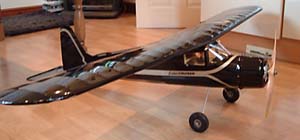 The
model looked beautiful, but even after all this time I still find myself
doubting that something of that size and weight can fly electric. Oh well,
it had to be done, so gently bringing in full throttle away she rolled,
building up speed quite quickly.
The
model looked beautiful, but even after all this time I still find myself
doubting that something of that size and weight can fly electric. Oh well,
it had to be done, so gently bringing in full throttle away she rolled,
building up speed quite quickly.
Within no more than 30 yards she eased effortlessly into the air and climbed steadily away. A little bit of trimming on the radio and she was flying beautifully.
I soon realised that I only needed just under half throttle for steady level flight. She handled like a dream. Within a couple of minutes she was fully trimmed, I got Louise to copy the trim settings on her transmitter, pointed the model into wind and handed over to Louise - no problem with Louise flying it on the first flight at all.
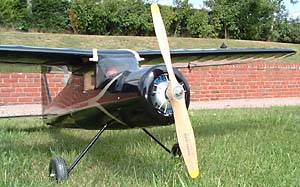 It
had been some time since Louise had flown, but having given her a little
time on the flight sim at home - one of the rare occasions I had handed
the computer over to her!! - She settled in really quickly, needed help
only once.
It
had been some time since Louise had flown, but having given her a little
time on the flight sim at home - one of the rare occasions I had handed
the computer over to her!! - She settled in really quickly, needed help
only once.
10 minutes or so later I decided that it was probably best if I bought it down rather than let the batteries go flat, as I wanted to see how it flew when it came to a landing.
I bought it down, did a couple of low passes to get the feel of it and then brought her in. No problem at all except when I went a little off line on the grass runway and into the long grass at the side making it flip. No damage done though.
I put the batteries back on charge but at that point it started to rain so off home we went - both very chuffed with the days flying.
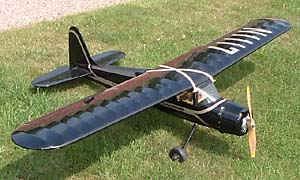 What
a day! All of Louise's efforts were rewarded better then we could have
imagined. Even with the heavy strong construction, heavier covering and
dummy radial there was absolutely no problem with it at all. Half throttle
was ample for normal flight and it looks like this will be another one
that is good for 15 minutes or so flying time.
What
a day! All of Louise's efforts were rewarded better then we could have
imagined. Even with the heavy strong construction, heavier covering and
dummy radial there was absolutely no problem with it at all. Half throttle
was ample for normal flight and it looks like this will be another one
that is good for 15 minutes or so flying time.
Can't wait to get back and fly it some more - Oh, sorry, I mean get back and give Louise some more lessons!
Next month I will at least cover my exploits in getting my Cirrus flying again. It was my 18th Birthday present from my parents and could never bring myself to throw it away even though it was in a terrible state - see how I brought it back to life after 24 years.
 I
also have made some great contacts around the world and will be acting
as UK Agent for a few of them.
I
also have made some great contacts around the world and will be acting
as UK Agent for a few of them.
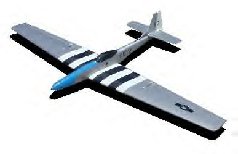
I am already in possession of a 60" Semi Scale EPP Slope Soarer from America that has been radar clocked at over 100 mph !!! I will be doing a full kit review as soon as I have it completed and it should come out at about £65 including postage shipped direct from the States - anyone want to come up to the Long Mynd or Malvern Hills and give me a refresher in Slope Soaring? I will have a range of models from this manufacturer available - they look great.
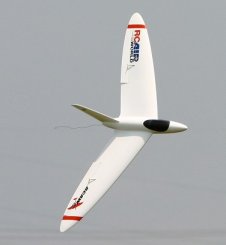 I
also have a 1.1M ARF Composite Flying Wing for Slope Soaring or Electric
Flight coming which should go out at about £120 plus postage. Again
I will have their full range available, predominantly ARF Composite gliders
from 1m through to 3.1 m - all of them beautiful!
I
also have a 1.1M ARF Composite Flying Wing for Slope Soaring or Electric
Flight coming which should go out at about £120 plus postage. Again
I will have their full range available, predominantly ARF Composite gliders
from 1m through to 3.1 m - all of them beautiful!
Also to come, if all works out are some nice scale power kits from America and I hope to start with a ¼ scale Tiger Moth. This may well be glow powered as I have a couple of RCV's just waiting for the right model. But I shall see how it goes once I have the kit as to whether it is glow or electric.
That's
it for now, I need to go and re-build my web site as I have so many new
models coming in that it will require a total re-write of my web site
to accommodate them all
If you have any questions then please get in touch with
Mark at:
sales@ratbyaeroplanes.com
or check out his web site at:
www.ratbyaeroplanes.com